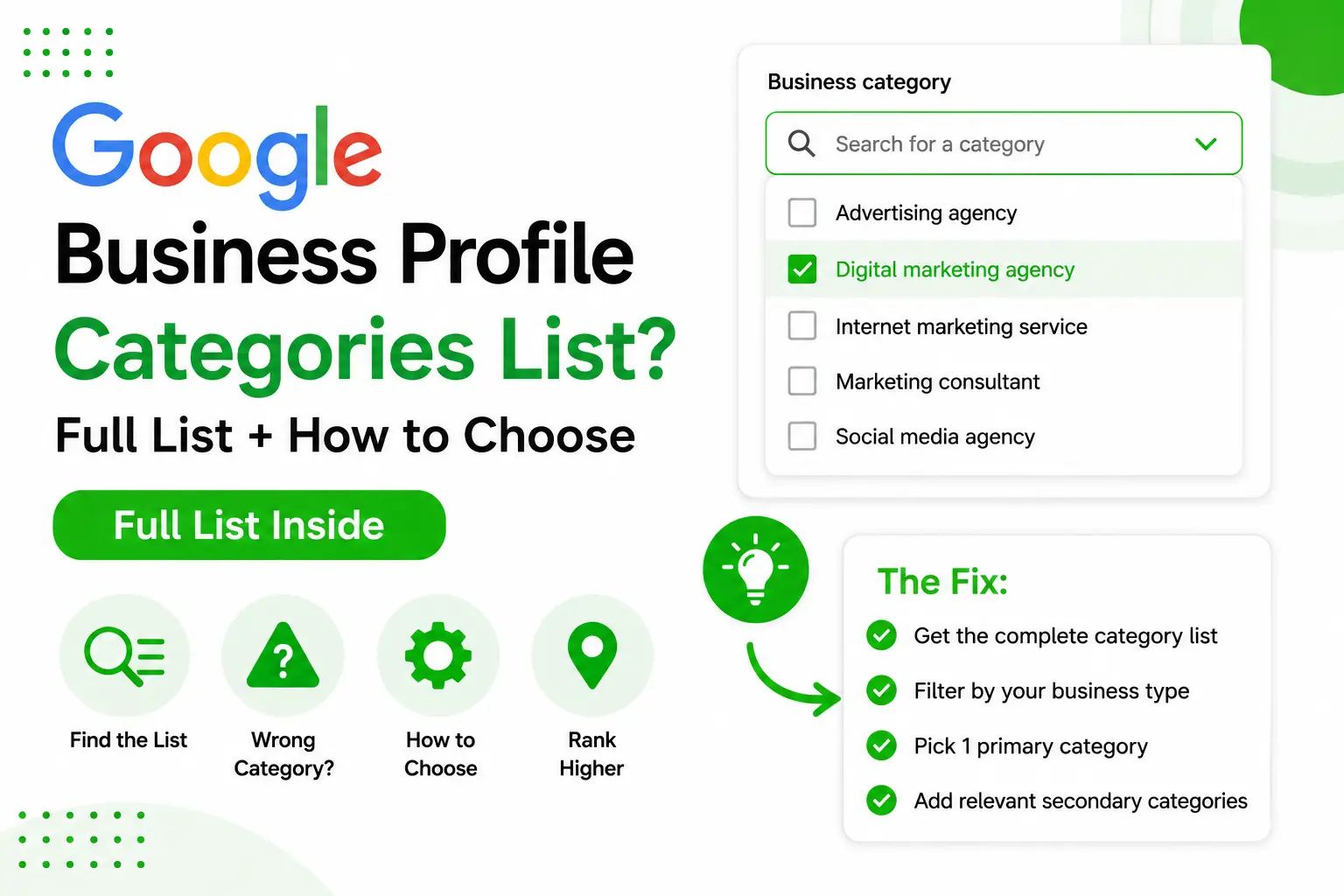

Setting up your Google Business Profile, you hit the category dropdown and it’s overwhelming. Thousands of options, and no clear way to search or filter through them properly inside the GBP dashboard itself.
Most business owners either scroll and guess, or open a competitor’s listing and copy whatever category they’ve used. Both approaches are risky — the dropdown search is limited, and your competitor may have picked the wrong category themselves.
I found a simple way to get the complete Google Business Profile categories list in one place, and then use AI to filter it down to exactly what fits your business. In this post, I’ll show you where to find the full list and exactly how to pick the right primary and secondary categories from it — takes about 5 minutes.
Why your GBP category choice matters
Your primary category is one of the strongest signals Google uses to decide who to show your business to in local search and Google Maps. Pick something too broad, too narrow, or simply wrong, and Google struggles to match you with the right searches — even if everything else on your profile is perfect.
This is why getting this one field right is worth the 5 minutes.
Part 1: How to find the full Google Business Profile categories list
Google doesn’t give you an easy, browsable list inside the GBP dashboard — you only see suggestions as you type. To see everything available, you need to go outside the dashboard.
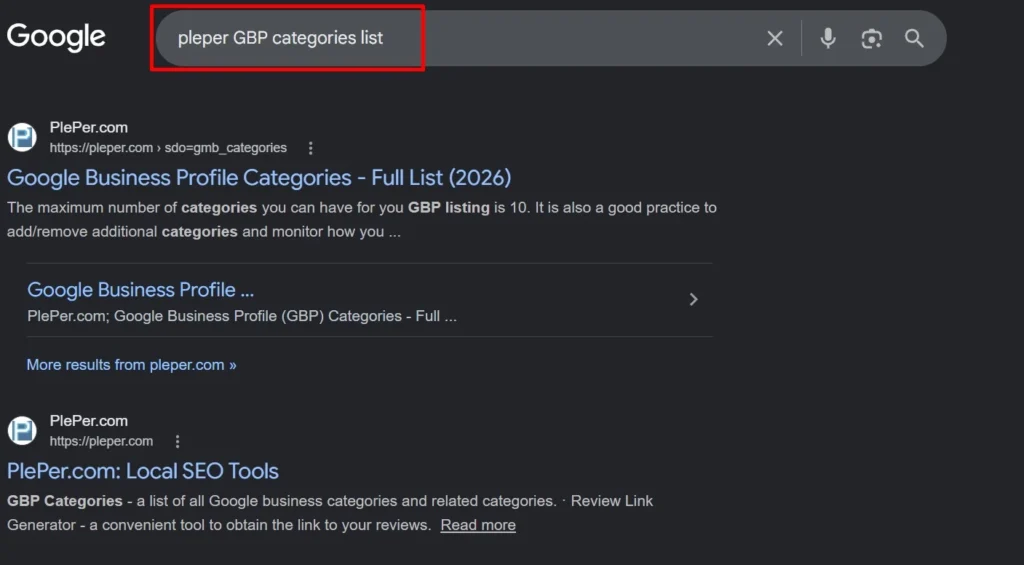
Step 1: Search for the Pleper GBP category list
Open your browser and search for “Pleper GBP category list” or “Pleper Google Business Profile categories list.” This brings up a website that maintains the full, updated list of official Google Business Profile categories.
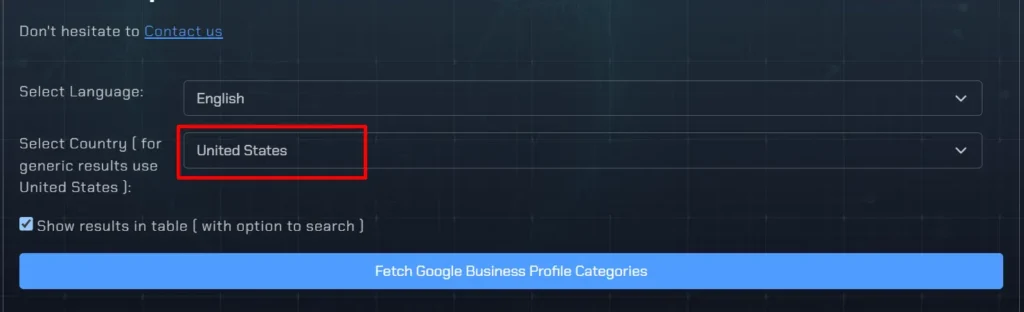
Step 2: Select your country
On that website, select your country and click Next. Category availability can differ slightly by country, so this step matters. Once selected, you’ll see the complete list of categories available for your country — often running into thousands.
Step 3: Extract the list into a usable format
Scrolling through thousands of categories manually isn’t practical. Instead, copy the URL of that list page and use an AI tool (I used Claude) to extract the entire list into an Excel sheet. This turns a long webpage into a clean, searchable spreadsheet.
Now you have the complete, official list sitting in front of you — something Google itself doesn’t hand you directly.
Part 2: How to choose the right category from the list
Having the full list is only half the job. Here’s how to actually pick the right one for your business.
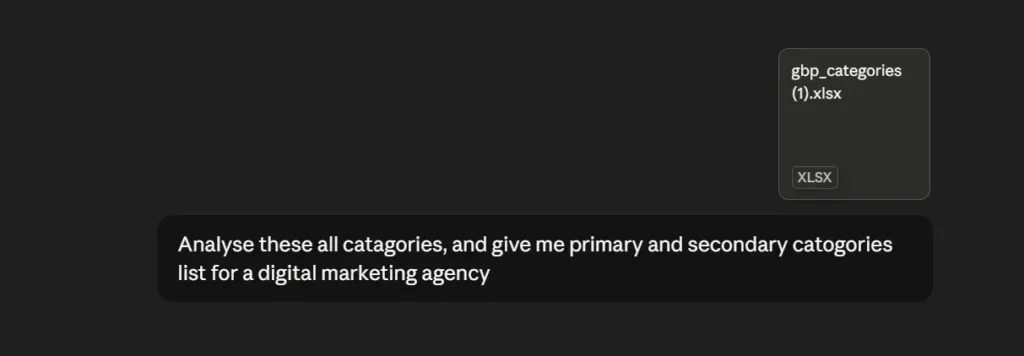
Step 4: Upload the list to AI and describe your business
Take the Excel sheet you extracted and upload it to an AI tool (i used Claude). Describe your business clearly and specifically — what you do, who you serve, and any niche details that matter. Then ask the AI to filter the list down to the categories that are genuinely relevant.
For example, if you run a physiotherapy clinic that also does sports injury rehab, say exactly that, instead of just “clinic.” The more specific your description, the better the filtered result.
Step 5: Pick one primary category and a few secondary categories
From what the AI shortlists, choose:
- One primary category — the single category that most accurately describes the core of your business. This carries the most ranking weight.
- A few secondary categories — additional categories that cover other real parts of what you offer, without straying into unrelated territory.
Step 6: Apply the categories to your GBP listing
Go to your Google Business Profile dashboard, set your primary category first, then add your secondary categories one by one.
Common mistakes to avoid
- Copying a competitor’s category — they may have picked the wrong one too, and you’d just repeat their mistake.
- Choosing a broad category (like “Store”) when a more specific one exists (like “Shoe Store”) — specific almost always wins.
- Adding too many unrelated secondary categories to “cover more searches” — this dilutes relevance instead of helping.
- Never revisiting your category — Google adds new categories over time, so what fit best a year ago might not be the most specific option anymore.
Questions I Get Asked Most
Where can I find the complete list of Google Business Profile categories?
How many Google Business Profile categories are there?
The number varies by country, but it typically runs into the thousands. This is exactly why manually scrolling through the dropdown inside GBP isn't practical for finding the best fit.
Should I copy the category my competitor uses?
No. Your competitor may have picked an incorrect or overly broad category for their own listing, and copying it just passes that same mistake on to your profile.
Yes. Since the full category list is long, AI tools are useful for filtering it down to the ones genuinely relevant to your business, based on a clear description of what you do.
Conclusion
You don’t have to guess your way through the GBP category dropdown or copy your competitor’s listing. Get the full official categories list, describe your business clearly to AI, and let it filter down the exact primary and secondary categories that fit. Five minutes, done properly.
Try this the next time you’re setting up or auditing your Google Business Profile.
Also Shared On:
Stop copying your competitor's Google Business Profile category.
— Deepanraj K R (@Deepanraj_k_r) July 26, 2026
They might've picked the wrong one too.
Here's the actual list + how to filter it for your business 👇#deepanraj #gbp #gmb pic.twitter.com/41grnCqIX8